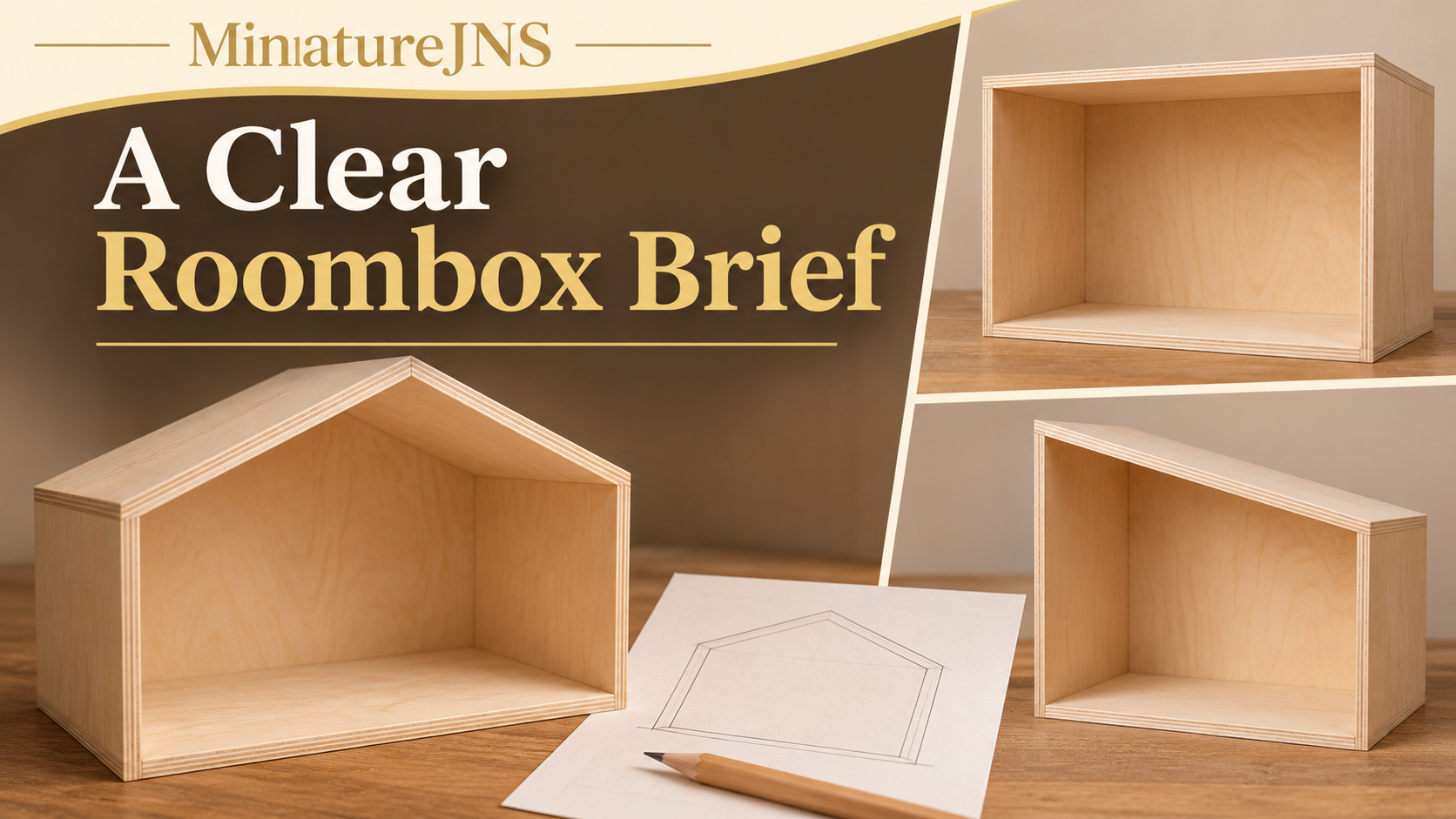
A roombox illustration can show the character of a miniature space: an arched courtyard, a small shopfront or a formal hall. It rarely answers every question a maker needs to quote the work. A useful manufacturer brief connects that visual idea to a written scope, a set of dimensions and a sample-review process.
The aim is to make the next conversation specific. You do not need to invent construction details yourself. Record what you want, identify what remains undecided and ask the maker to explain how they would produce it.
Identify the exact design
Begin with the design name, reference number and the original image. If a sheet contains several concepts, state which one you mean. Mark the views that matter most and describe the intended use, such as an unfinished shell for a collector to decorate.
The JNS unfinished room-box concept gallery uses numbered designs for this purpose. Its illustrations are concepts, not photographs of manufactured inventory. They do not by themselves establish materials, scale, included features, price or availability.
Ask what additional views the maker needs. A front perspective may leave the back, underside, roof access or hidden joins unresolved. A short list of unanswered questions is more useful than assuming those details will match your expectations.
Separate outside dimensions from usable space
Write down the proposed overall width, depth and height, then ask the maker to confirm the usable internal measurements. Wall thickness, trim, stairs and curved sections can affect the space available for a scene.
State whether the outside size or the inside room space is the priority. If a display must fit on an existing shelf, give the available shelf space. If it must accommodate specific miniatures, supply their measured dimensions and ask how much space remains around them.
For the three JNS jail concepts numbered 51–53, the owner has proposed an overall size of 10 × 10 × 10 inches. That is a proposal awaiting final specifications, not a size shared by all 53 concepts. Other designs need their own dimensions.
Define what the unfinished shell includes
List the architectural parts you want the maker to consider: the base, walls, openings, roof sections, stairs or galleries. Separate the features you consider essential from those you are willing to simplify after discussion.
Then write an explicit exclusion list. For the current JNS concept collection, the requested scope is plain unfinished plywood, raw inside and outside. Furniture, décor, lighting, paint, stain, varnish, wallpaper, applied flooring finishes, cabinets, shelving, glazing, nonwood fittings and scenery are excluded. Some illustrations show details that still need a scope decision; a visible feature should not silently become a promise of an included part.
If you want to add something outside that scope, name it and ask for a separate option. This makes two quotations easier to compare and prevents a lower price from being mistaken for the same package of work.
Ask for a practical material and assembly proposal
The JNS request is for plywood rather than MDF or a finished wood substitute. Ask the maker to confirm the plywood grade, thickness, surface treatment, joint construction and any design limitations. Request sample photographs of both faces and cut edges to agree on the raw appearance before production.
Discuss whether the shell would arrive assembled or as a flat-pack kit. For a kit, ask what joins, instructions and additional assembly supplies are expected. For an assembled shell, ask how it will be packed and how the buyer can reach the interior for decorating.
Be specific about illustrated details that may be difficult to reproduce, such as curved walls, narrow columns or complex staircases. Ask for the proposed solution and any change to the design before approving it.
Plan one prototype and a clear review
A sample gives you something concrete to assess. Ask the maker what the prototype will demonstrate, what it will omit and whether it uses the same materials and process proposed for later units.
Agree on the review points before the sample is made. These might include the overall measurements, usable interior space, the fit of separate parts, access for decorating and the agreed finish. Request clear photographs of relevant views, but do not treat photographs alone as proof of every measurement or construction detail.
Also ask how revisions are handled. Find out what a change would cost, what it would do to the lead time and whether another sample would be needed. One accepted prototype is a reference for later work, not a guarantee that every future unit will be identical.
Separate development charges from repeat-unit costs
Request distinct figures for design or CAD preparation, the sample, any revisions and subsequent units. Ask what production files you will receive and what arrangements apply if you later need a replacement part or another maker.
If your aim is one-piece-at-a-time fulfillment, say so directly. A workshop that welcomes a single prototype may still have different terms for repeated individual orders. Confirm the repeat quantity, lead time, packaging and shipping charge rather than treating a general no-minimum statement as a project agreement.
For direct delivery to customers, ask about delivery areas, neutral packaging, tracking and the process for damaged or incorrect items. These services need confirmation; they should not be advertised to customers merely because the workshop ships its own products.
Keep the approved version together
Before production, bring the reference image, drawings, dimension notes, inclusion list, exclusions and quotation into one agreed version. Give it a date or revision label so a later change is easy to identify.
Keep open questions visible until they are answered. If a particular scale, opening mechanism, material or delivery service is important, it belongs in the written specification rather than in an assumption about the picture.
To discuss a JNS concept, contact JNS Miniatures with the design number and the dimensions or display requirements you have in mind. Manufacturing, final specifications, pricing and availability must be confirmed for the proposed project.

No Comments
[…] help you communicate an architectural idea, but it is not a complete manufacturing specification. Before commissioning a shell, agree on the usable dimensions, materials, included features and how it will be assembled or […]