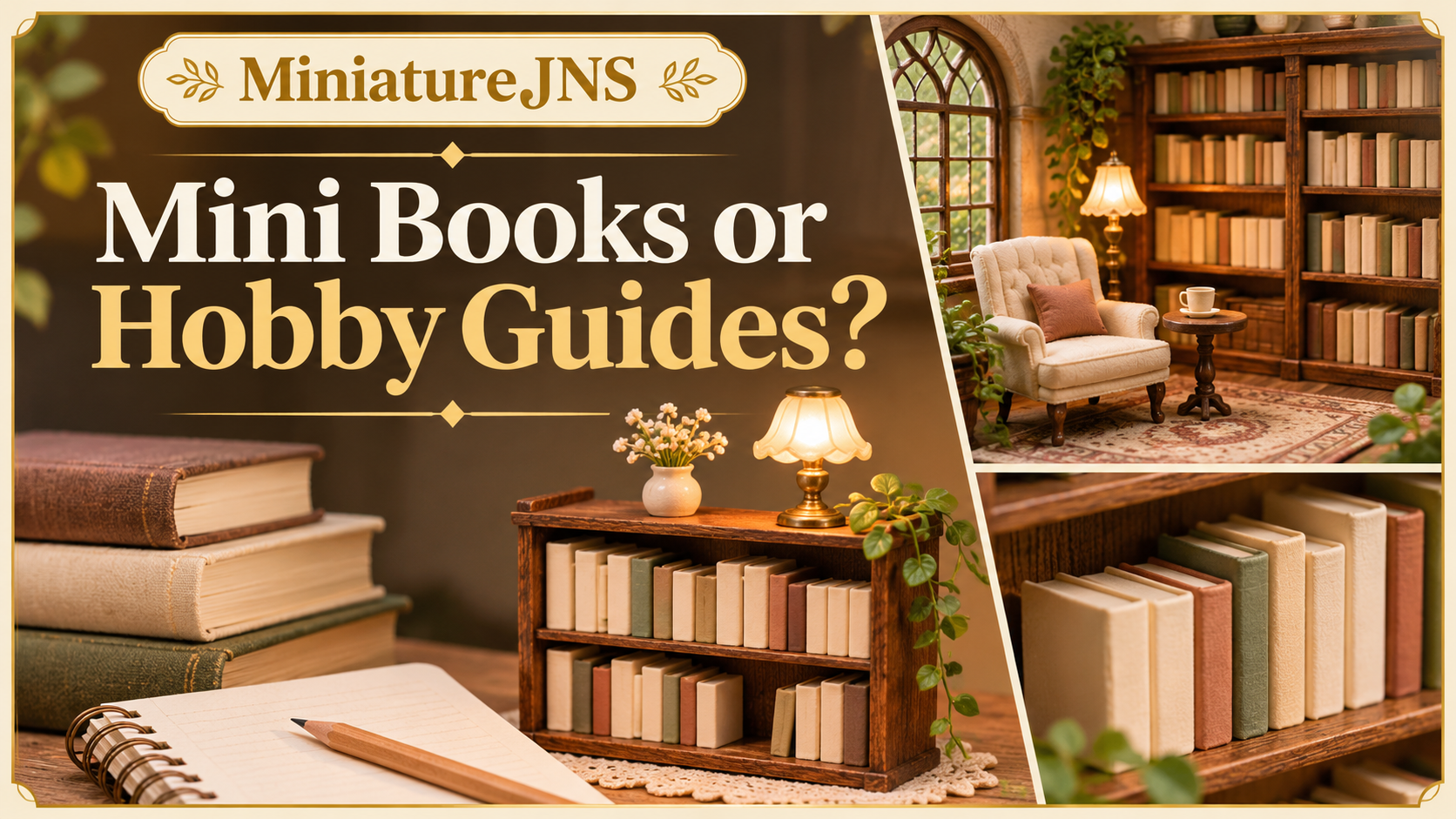
A miniature library scene and a book that helps you plan a dollhouse project serve different purposes. Both may appear during a search for dollhouse books, but they answer different needs. One belongs in the scene you are arranging; the other is something you may want to consult while working on a project. Start by deciding which job you need the item to do.
Then look beyond the word “book.” The category, exact listing and stated details should help you decide whether an item suits your display or your research. A familiar title or an attractive photograph cannot answer every question about size, contents or format.
Choose the purpose before the title
If you are furnishing a reading room, placing books on a desk or filling a miniature shelf, begin with miniature library accessories. Think about how the books will appear in the scene: standing in a row, lying in a small stack, or resting beside a chair. That decision helps you identify the measurements and presentation details you need to check.
For a publication to consult while planning a project, browse the How To Books reference listings. Here, the useful questions concern the subject, format and information included. The category is a starting point, not a substitute for those details.
Keep the two purposes separate when comparing options. A miniature book-shaped accessory is not automatically a readable publication, and a hobby reference listing is not automatically a miniature-sized volume for a shelf. Choose by intended use before comparing colors, titles or room themes.
Keep the exact listing in view
Save the product link and SKU when an item interests you. If you later ask a question, those details keep the conversation attached to the right record. A shortened title alone can be difficult to distinguish from another listing.
For example, the JNS How To Books category includes COLONIAL D.H.CONSTRUCTION, SKU CK1015-3, and TOWNSEND TOWERS, SKU HW1003. Both are listed in the store’s How To Books category. That tells you how they are presented in the store, but it does not establish an author, edition, page count, binding or publication format.
If one of those details matters to your choice, confirm it before ordering. A title that suggests a building project should not be treated as a promise that a particular plan, drawing or construction method is included.
Measure for the way you will display a miniature book
For a scene accessory, check the product’s stated scale and actual dimensions against the space you have available. A shelf opening, the depth of a desk and the surface beside a chair create different requirements. A piece that looks suitable for the room’s theme may still need a measurement check.
Consider the arrangement as well as the individual item. If you want upright books, check the available height and depth. If you want a stack, consider its total height and footprint. If the photograph shows several pieces together, confirm what the listing actually includes rather than treating everything pictured as one purchase.
Where the information is missing, ask a specific question: “What are the height, width and depth of this item?” That is more useful than asking whether it will fit your library, because the answer can be compared with your own measurements.
Check details that affect the scene
A closed book on a shelf and an open book on a desk create different visual effects. If your arrangement depends on opening pages or readable print, confirm that feature for the exact product. Do the same for an included stand, a grouped set or any other part that affects the display.
The category name does not establish those features. Neither does a recognizable book title establish that the miniature contains the full text of the original work. Base the decision on the individual listing and any clarification you receive.
You can also plan the scene without relying on an unconfirmed feature. Decide whether the effect you want comes from the visible spine, the position of the item or its relationship to nearby furniture. That gives you a clear brief when comparing listings.
For a reference, ask what you will be able to consult
Think about the question you want a reference to answer. Are you researching a style, looking for project instructions or comparing approaches to a build? Write down that purpose before deciding whether a title is relevant.
Then confirm the publication details that support it: subject coverage, language, format, author or publisher, edition and page count where relevant. These are questions to resolve, not assumed specifications of the two JNS reference examples above.
If you need a particular diagram or type of instruction, ask about that directly. A useful comparison is based on confirmed contents, rather than a guess drawn from an abbreviated name.
A short checklist before choosing
- Am I selecting a scene accessory or a hobby reference?
- Have I saved the exact product link and SKU?
- For a display piece, are its stated scale and actual dimensions suitable for my space?
- Are the included pieces and any important features confirmed?
- For a reference, do I know enough about its subject and format to judge its usefulness?
Use unanswered questions to guide a short clarification request. Include the link, SKU and the one or two details that would change your decision. Choose by intended use first, then verify the details of the exact listing. That makes it easier to find either the right finishing touch for a miniature reading room or a reference for the project behind it.
