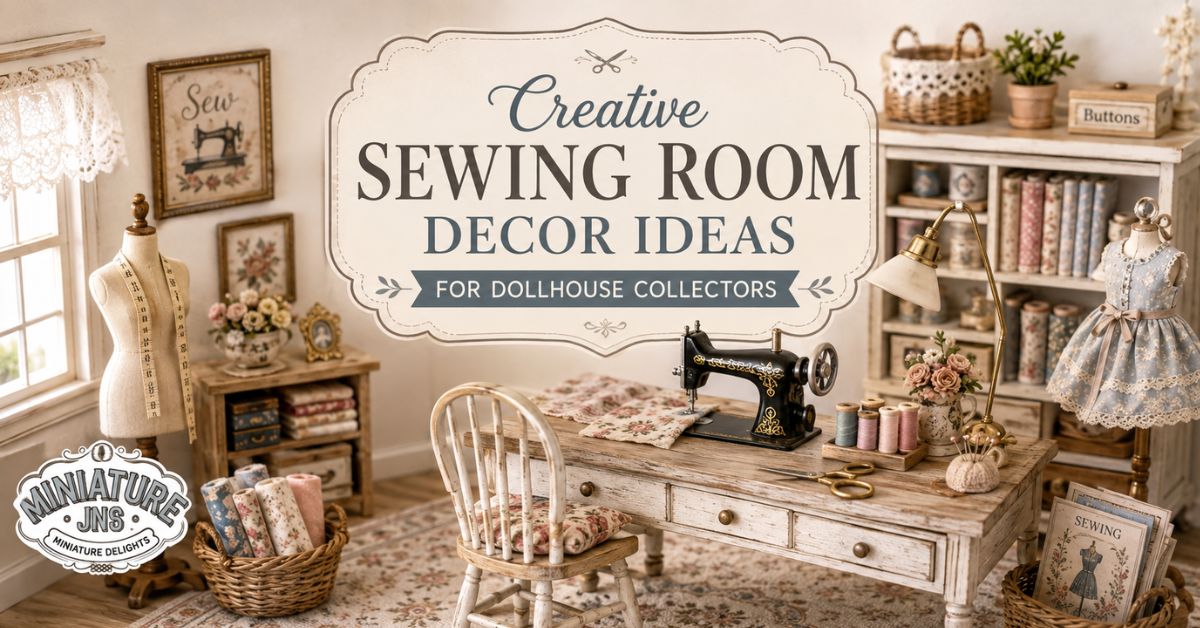
A miniature sewing room is one of the most rewarding scenes a collector can build. It has everything a good room needs: a clear purpose, plenty of small objects, strong colour, rich texture, and a natural sense of work in progress. Unlike a formal parlour, a sewing room is allowed to be a little messy — and that freedom is what makes it fun.
Miniature JNS carries the small pieces that bring these rooms to life, from machines and notions to baskets, shelving, and trim. Here are ideas for building a sewing room that looks creative rather than merely arranged.
Start With the Sewing Table as Your Anchor
Every sewing room needs one clear centre, and that is almost always the machine and the surface it sits on. Get this right and the rest of the room organises itself around it.
Put the sewing table and storage footprints into your room-planning checklist before adding smaller accessories. Keep the exact source, SKU and storage location of each chosen piece in a miniature collection inventory.
Choose your machine first, because it sets the period of the whole scene. A treadle machine with a cast-iron base and a wooden cabinet places the room in the late nineteenth or early twentieth century. A hand-crank machine suggests an earlier or more modest household. A boxy electric machine from the mid-century gives you a completely different colour palette and mood. A modern computerised machine works for a contemporary craft room.
The table matters as much as the machine. A dedicated sewing cabinet with a drop-in top looks purposeful. A repurposed dining table looks like someone converted a spare bedroom, which is often more relatable. A long work counter suits a serious hobbyist or a small business. Whichever you pick, leave usable space beside the machine — real sewers always need somewhere to lay fabric down.
Then consider a second surface, such as a cutting table, ironing board or side table. Check its actual height and footprint against the layout, and confirm whether any folding or opening feature is specified. Browse the sewing collection for display pieces; a miniature machine or tool should be treated as decorative unless its exact listing confirms another function. Use the miniature product checklist to compare dimensions and included components.
Build Storage That Looks Used, Not Staged
Sewing generates an enormous amount of small stuff, and storage is where a miniature sewing room earns its realism. This is the part that separates a convincing scene from a tidy showroom.
Open shelving is your best friend. Shelves let you display fabric, thread, boxes, tins, and jars where the viewer can actually see them. Fill them unevenly. Real shelves have a tightly packed section, a half-empty section, and one shelf that has become a dumping ground. Perfectly spaced items look like a shop.
Spools of thread are the signature detail of this room. A rack of spools in mixed colours is instantly recognisable and adds a burst of colour that nothing else provides. You can mount a rack on the wall, stand one on the table, or simply let loose spools sit in a shallow dish. A few spools lying on their sides looks better than every spool standing to attention.
Baskets are enormously useful here. A basket of scraps under the table, a basket of finished pieces on a shelf, and a small basket of notions on the counter give the room depth without adding clutter. The baskets range offers shapes and sizes that work well for craft storage.
A dress form or mannequin deserves special mention. It is one of the few objects that fills vertical space, casts an interesting shadow, and reads clearly from across the room. Drape a half-finished garment on it and you have an instant story.
Use Fabric and Colour to Set the Mood
Fabric is the reason sewing rooms photograph so well. It brings pattern, softness, and colour into a space that would otherwise be dominated by wood and metal.
Stack folded fabric in varied heights. A tall stack, a short stack, and one piece unfolded across the cutting table gives natural rhythm. Vary the patterns too — a plain, a stripe, a small floral, and a solid together look far more real than four coordinated prints, because real sewers accumulate fabric over years rather than buying it as a set.
Choose a loose colour direction for the room. A soft palette of cream, sage, and dusty rose suggests a gentle, traditional space. Deep reds, navy, and brown suggest a workroom or tailor’s shop. Bright primaries suggest a modern craft room or a children’s clothing project. You do not need everything to match, but a rough direction stops the room from looking chaotic.
Scraps are worth including deliberately. A few offcuts on the floor near the cutting table, a pincushion with pins in it, a length of ribbon trailing off the edge of the counter — these say the work is happening now. A completely clean floor in a sewing room is one of the least believable things you can build.
Decorate the Walls and Window
Sewing rooms are working spaces, so wall décor should feel practical rather than purely ornamental. That constraint actually makes the decorating easier.
Pegboards and hanging rails are ideal. Scissors, rulers, tape measures, and hoops hung on a wall look organised and give you a display surface that does not eat floor space. A row of hooks with bags or aprons hanging from them does the same job more casually.
A small notice board with pinned patterns, sketches, fabric swatches, or postcards adds personality. This is where you show taste — what this particular person finds inspiring. It is one of the few places in a sewing room where you can be openly decorative without breaking the logic of the space.
For the window, choose something light. A sewing room needs daylight, so heavy curtains work against the story. A simple cotton curtain, a half-café curtain, or a plain blind lets you suggest brightness. Position the machine or cutting table near the window if the layout allows — that is what a real sewer would do, and viewers register the logic even if they cannot name it.
Lighting is worth planning. A task-lamp shape over the machine and a ceiling fixture can suggest a working room even when both are decorative. If you want powered lighting, confirm the exact lamp’s supply, voltage, connectors and included components using the dollhouse lighting compatibility guide; appearance alone does not establish electrical compatibility.
Add the Details That Prove Someone Works Here
The last layer is the most important, and it costs almost nothing. It is simply the discipline of asking, at every step: would a real person leave it like this?
Leave the scissors open on the table rather than closed and squared to the edge. Let the tape measure curl instead of lying flat. Put a cup or a teapot somewhere on the counter — sewing is slow work, and there is always a drink going cold nearby. Leave a pattern envelope with the pattern half out of it. Drape a measuring tape over the back of the chair or around the dress form’s neck.
Scatter, but do not swamp. Three or four deliberate imperfections read as life. Twenty read as an accident. The trick is to place each one on purpose while making it look accidental.
Finally, step back and check the story. Who sews here? A grandmother making quilts, a dressmaker taking commissions, a teenager learning on a hand-me-down machine, or a small business packing orders? Every one of those people would keep a different room. Choose one, and let that choice guide what you add and — just as importantly — what you leave out.
A sewing room does not need to be perfect to be beautiful. It needs to look like somebody’s, and the small creative choices you make about fabric, storage, walls, and mess are exactly what give it that ownership.
