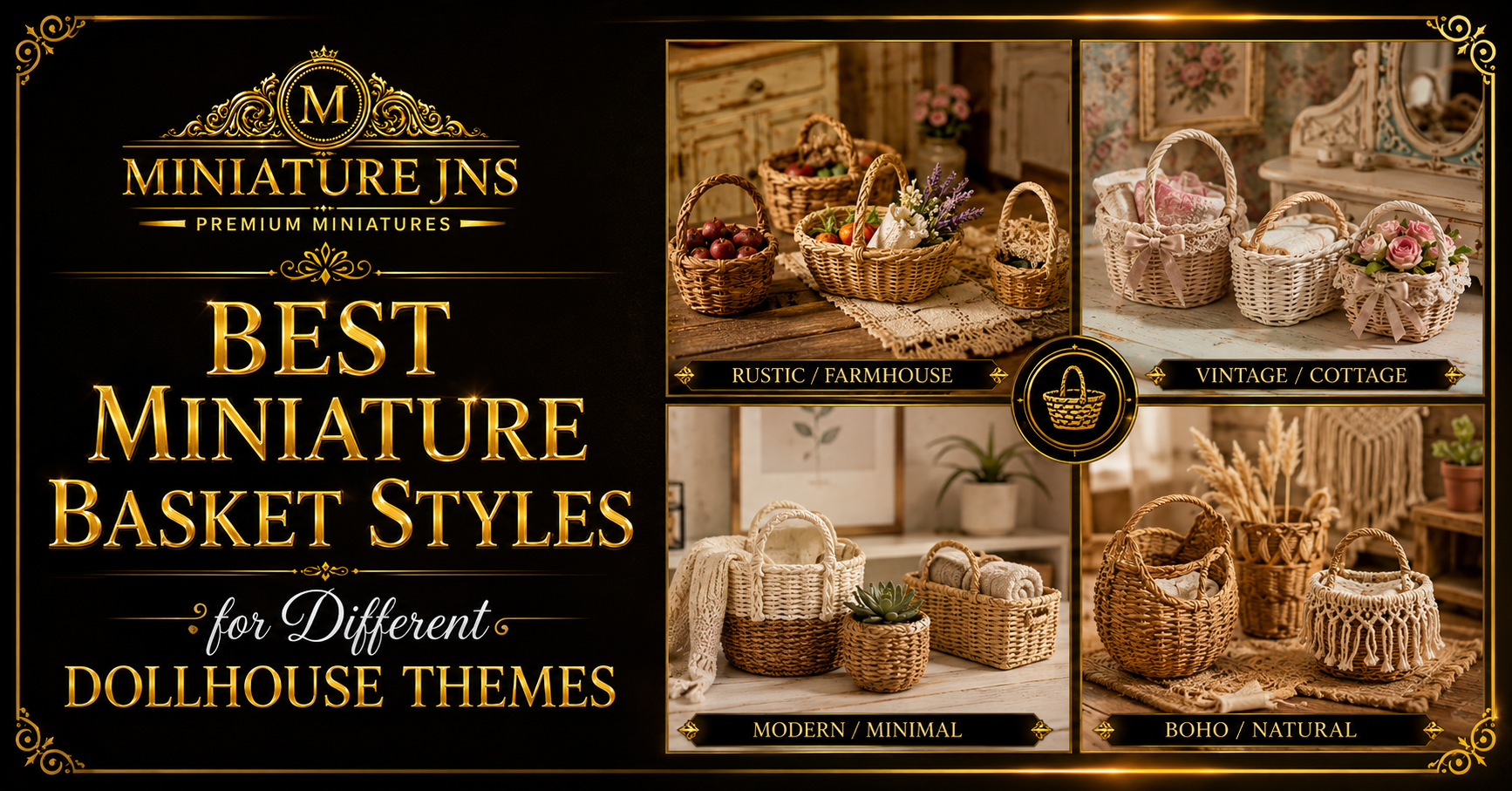
Baskets are the quiet workhorses of dollhouse building. They cost little, they fit almost every room, and they solve a problem that no other accessory solves as neatly: they add texture to spaces dominated by hard, smooth surfaces.
They are also one of the few objects that appear in every period of history and every level of household. A Victorian mansion and a farm cottage both contain baskets. So does a modern apartment, a garden shed, and a village shop. The difference is in the shape, the weave, and what goes inside.
Miniature JNS carries a wide range of shapes and sizes. Here is how to match basket styles to the theme of the house you are building.
Why Baskets Work in Almost Every Room
Before choosing styles, it helps to understand why baskets have such a strong effect at this scale.
Most miniature rooms are built from hard materials — painted walls, wooden floors, ceramic, glass, metal. The eye reads all of that as smooth. A woven basket introduces a completely different surface, full of small repeated detail that catches light unevenly. That contrast makes both the basket and everything around it look more three-dimensional.
Baskets also imply activity. A basket is a container for something in transit — laundry going somewhere, vegetables coming in from the garden, firewood brought in from outside. Placing one in a room suggests movement and a task rather than static decoration.
Farmhouse and Country Themes
This is the natural home of the basket, and the style where you can use the most of them without the room feeling crowded.
Look for natural, undyed wicker and willow in generous, practical shapes. Egg baskets with high handles, shallow harvest trugs, deep gathering baskets, and round market baskets all belong here.
The picnic basket is a particular favorite in country scenes. Whether packed with a checked cloth and small dishes or sitting empty on a shelf, it reads instantly and works indoors and out. A picnic hamper on a kitchen table, by a back door, or loaded onto the back of a bicycle is one of the most charming details available.
Fill farmhouse baskets with produce. Apples, potatoes, onions, eggs, bread, a bunch of herbs. Vegetables in a basket by the kitchen door imply a garden and a season, which does more storytelling than most furniture.
Also use them structurally. A large basket of firewood beside the hearth, a laundry basket by the stairs, or a basket of kindling under a bench fills awkward floor space in a way that looks purposeful rather than decorative.
Victorian and Formal Homes
Formal homes use baskets differently. Here they are refined, specific, and usually associated with a particular activity rather than general storage.
The sewing basket is the classic Victorian piece — often lidded, sometimes lined with fabric, and placed beside a chair in a parlor or bedroom. It signals a lady of the house and a room used in the evening. Leave the lid slightly open with a spool or a scrap of fabric visible.
Flower baskets and trugs suit conservatories, hallways, and garden rooms. A shallow trug with cut flowers laid in it, rather than arranged, looks like someone has just come in from the garden.
Log baskets beside a fireplace are correct for the period and add substantial texture to a formal room without looking rustic, especially in darker willow or with a metal frame.
Keep formal baskets neater and more contained than country ones. A Victorian parlor with three overflowing wicker baskets looks like a cottage. One lidded sewing basket beside a chair looks like a townhouse.
Coastal, Garden, and Outdoor Scenes
Outdoor and coastal themes are where baskets get to be visible and slightly weathered.
For garden scenes, use trugs, gathering baskets, and open-topped carriers. Fill them with cut flowers, seedlings, garden tools, or vegetables. A basket left on a path, a bench, or a low wall implies someone working nearby who has stepped away.
Bicycle baskets deserve a mention here. A front-mounted basket on a miniature bicycle, holding flowers, a loaf of bread, or a small parcel, is one of the most photographed details in the whole hobby for good reason.
For coastal scenes, look for lighter, more open weaves, and consider painted or bleached finishes. Baskets holding shells, rope, towels, or beach items suit a porch or a seaside cottage. A basket by a door holding sandals reads immediately.
Baskets also work well hanging. A basket on a hook by a shed door, hanging from a beam, or suspended in a porch adds height to exterior scenes that often stay low. Pair them with pieces from the garden range for a complete outdoor corner.
Modern Homes and Shop Scenes
Modern interiors use baskets too, but with tighter shapes and more restraint.
Look for clean, geometric forms — square or rectangular bins, low round bowls, and lidded boxes. Neutral tones, pale natural fibers, gray, black, and white all suit contemporary rooms. Avoid heavily rustic weaves, which fight against clean modern lines.
In a modern home, baskets are storage rather than agriculture. A basket of throws beside a sofa, a laundry bin in a bathroom, a low basket of magazines by a chair, a bin for children’s toys in a corner. Each one implies tidiness and organization, which is exactly the modern signal.
Shop scenes are the other place baskets shine. A bakery with bread baskets on the counter, a greengrocer with produce in tiered baskets, a florist with buckets and trugs, a general store with baskets of goods stacked by the door. Retail displays use repetition, so this is one context where five identical baskets look right rather than lazy. Combine them with fixtures from the store and shelves range to build a convincing shop front.
Filling and Placing Them Well
Whatever the theme, a few habits separate baskets that look real from baskets that look like props.
Before choosing a basket, use a miniature room plan to record the shelf or surface where it will sit. Our listing-reading checklist helps you keep unconfirmed size, material and package contents separate from verified details.
Never place a basket squared up to a wall. Real baskets get set down at angles, pushed slightly out of line, or left where someone dropped them. A small rotation makes an enormous difference.
Vary the fill levels across a room. One basket overflowing, one half full, one empty and tipped slightly on its side tells a story of use. Three identically filled baskets look like stock.
Let contents spill over the rim. A corner of fabric hanging out, a flower stem projecting sideways, a shirt sleeve escaping. Contents contained perfectly inside the rim always look staged.
Use a mix of sizes. A large floor basket, a medium tabletop basket, and a small hanging one in the same room give the eye a range and make the scale of the room clearer.
Finally, put them where a real person would. Beside doors, under tables, at the foot of stairs, next to chairs, near hearths, on countertops. Baskets live at the edges of rooms and in the places where tasks happen, not in the middle of the floor.
Choose the weave that fits your period, fill it convincingly, angle it, and set it somewhere useful — and a handful of small baskets will add more warmth and texture to your house than almost anything else you can buy for the price.
