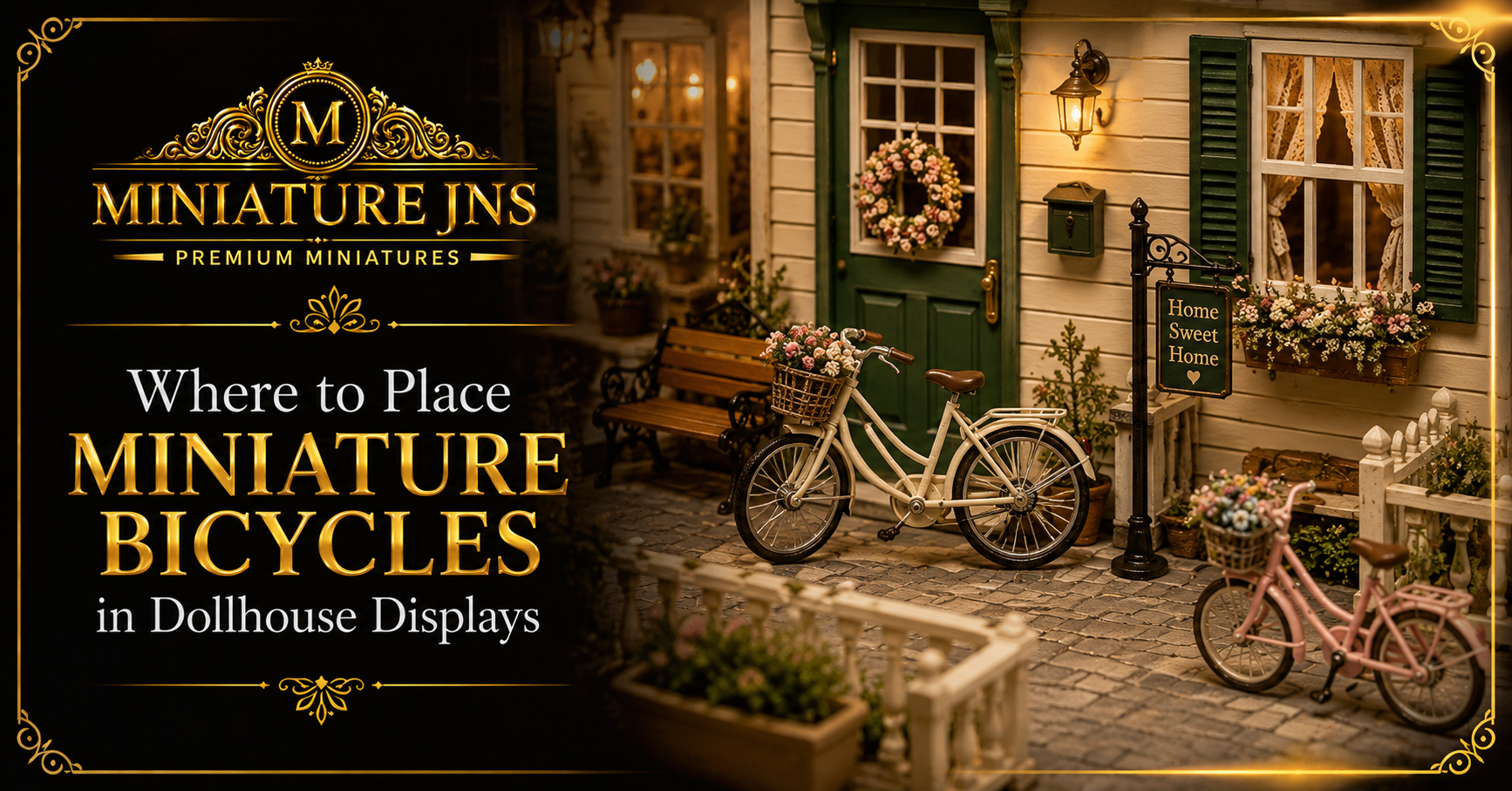
A miniature bicycle is one of those accessories that seems like a small addition and turns out to change a whole display. It brings movement into a static scene, fills awkward empty space, and immediately suggests someone who comes and goes.
The trouble is that a bicycle is also easy to place badly. Stood upright in the middle of a room or left floating on a lawn with nothing to lean against, it looks like exactly what it is: a model on a shelf. Bicycles need support, context, and a reason to be where they are.
This guide suggests places to display a miniature bicycle or trike and details to check for a convincing arrangement. Confirm the exact model’s dimensions and fixed or movable features before choosing its position.
Why a Bicycle Adds So Much to a Scene
A bicycle is unusual among miniature accessories because it implies a person who is not in the picture.
Furniture tells you a household exists. A bicycle tells you someone left the house this morning, or is about to. It carries the suggestion of a journey — to work, to school, to the shops — and that gives a scene a sense of the wider world beyond the walls of the model.
It is also visually useful. A bicycle has an open, skeletal shape that reads well against a plain wall or fence. Unlike solid furniture, it lets background show through, so it adds interest without blocking anything. Those two circles and the diagonal frame create a shape the eye finds instantly readable, even in a busy scene.
Check the miniature bicycle’s stated scale and exact dimensions against your doorway and path. Bicycle types and model proportions vary, so use measurements rather than the photograph alone when planning the display.
Against the Front of the House
The exterior wall is the classic placement and the easiest to get right.
Lean the bicycle against the front wall, beside the door, under a window, or against a porch post. The key word is lean — a bicycle resting at a slight angle against a solid surface looks natural, while one standing perfectly upright looks staged unless it has a visible kickstand.
Choose the wall carefully. A bicycle against dark brick or stone can disappear. Against a pale rendered wall, a painted door, or a light fence, the frame and wheels read beautifully. If your wall is dark, consider a light-colored bicycle or add a small contrast behind it.
Porches deserve special attention. A bicycle on a porch, half in shadow, next to a chair or a pair of boots, creates one of the most homely arrangements in the hobby. It suggests routine — this is where the bike always goes.
Front fences and gates work too. A bicycle propped against a picket fence or leaning on a gatepost tells the viewer someone has just arrived and not yet gone inside. Leave a small gap between the wheel and the fence rather than pressing them together; real bikes rest at an angle with the pedal or handlebar taking the weight.
Gardens, Paths, and Yards
Outdoor scenes are usually less populated than interiors, and a bicycle is one of the best ways to fill them.
Place a bicycle on a garden path rather than on grass. Bikes get pushed along paths and dropped where the hard surface ends. A bicycle lying on its side on a lawn is also perfectly realistic — that is exactly how a child leaves one — and it makes a lovely, casual detail that few collectors think to try.
Against a shed, a greenhouse, a wall, or a tree are all strong options. A bicycle leaning against a garden shed with tools nearby suggests a working yard. Against a tree in a front garden, it suggests a stop rather than a home.
A trike beside a larger bicycle can suggest a family setting. Before choosing models, compare their stated dimensions, poses and included stands using the miniature listing checklist. A scene idea does not establish which styles are currently offered in the catalog.
Think about the season and story. A bicycle with a basket of flowers suggests summer and a morning at the market. One with a bag or a parcel strapped to the rack suggests errands. A muddy bike propped by a back door suggests a wet ride home.
Indoor Placements That Work
Bicycles indoors are less obvious but often more interesting, because they suggest a specific kind of household.
A hallway is the most common real-world indoor spot. A bicycle against a hallway wall, near the front door, under the stairs, or beside a coat rack is completely believable in a townhouse, an apartment, or a modern family home. It is also a good way to fill a narrow hall that is hard to furnish.
Sheds, garages, and outbuildings are natural homes for bicycles, and they let you build a whole small scene around one. A bicycle up on a stand or turned upside down for repairs, with tools and a pump nearby, turns a plain shed into a workshop with a story.
Shops and commercial scenes work well too. A delivery bicycle with a large front basket outside a bakery or grocer is a period-correct detail with real charm. A bicycle repair shop is an entire roombox subject in itself.
The one placement to avoid indoors is a formal room. A bicycle in a Victorian parlor will look like a mistake unless you are deliberately telling a story about it.
Getting the Position and Angle Right
The physical position of the bicycle is what separates a good placement from a great one, and it comes down to a few small decisions.
Bicycles do not stand on their own. Unless yours has a working kickstand, it needs to lean, rest against something, or lie down. A bike balanced upright with no support is the most common realism error, and viewers notice it even if they cannot explain why.
If the model has a movable front wheel, a slight turn can make the parked position look natural. Keep a fixed wheel in its original position; do not force a handlebar or fork to move.
Vary the position of movable pedals only if the model is designed for adjustment. Fixed pedals can remain as supplied; the angle of the whole bicycle can provide the variation instead.
Think about the shadow. A bicycle casts a wonderful shadow of thin lines and circles. If your display is lit, position the bike so that shadow falls onto a plain surface — a wall, a path, a floor. It is one of the most attractive lighting effects available in miniature.
Finally, dress it. A basket on the front, a bell on the handlebars, a bag on the rack, a small bunch of flowers, a newspaper, or a chain and padlock all add character. Weathering helps for older scenes: a little dulling on the frame, a touch of rust at the joints. Pieces from the outdoor accessories range help build the surrounding world so the bicycle looks like it belongs rather than like it was placed.
A miniature bicycle can suggest a journey or a daily routine. Choose a position that supports the model without stressing delicate parts, keep fixed components as supplied, and add surrounding details that suit your scene.
