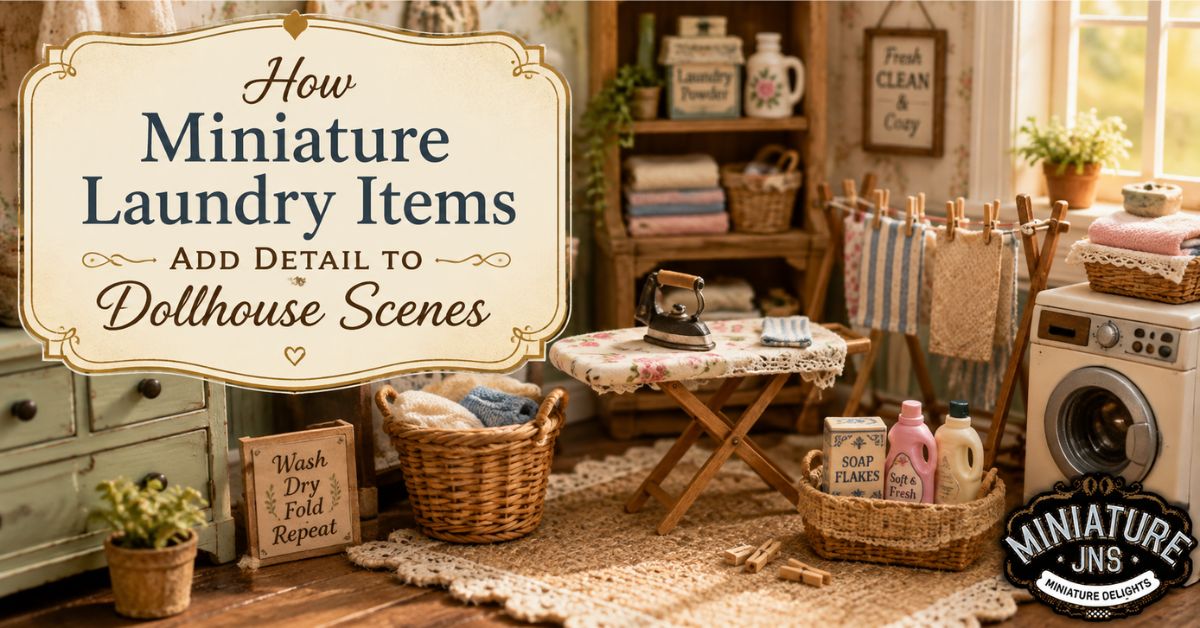
Most dollhouse builders spend their time on the pretty rooms. The parlour gets the good sofa. The dining room gets the porcelain. The bedroom gets the quilt and the little pair of slippers by the bed. Meanwhile, the laundry — the room where real life actually happens — gets forgotten.
That is a missed opportunity, because laundry is one of the most convincing subjects in the whole hobby. Nobody stages a laundry basket. Nobody arranges a clothesline to impress guests. When a viewer sees a small pile of folded towels or a shirt waiting on an ironing board, they do not think “collection.” They think “someone lives here.”
Miniature JNS stocks the small everyday pieces that make this kind of scene possible. You do not need a whole dedicated room to benefit from them. Even a single basket in the corner of a hallway will change how a house reads.
Why Laundry Details Feel So Real
Realism in miniature is not about how expensive a piece is. It is about whether the viewer believes a person made that arrangement for a practical reason.
Laundry items also carry a strong sense of time. A wooden washtub and washboard place a house firmly in the nineteenth century. A wringer washer suggests the early twentieth. A front-loading machine with a laundry pod tub says modern. Very few object groups date a scene so quickly or so clearly, which makes laundry a useful tool when you want a room to say something about its period without a word of explanation.
The Main Pieces That Build a Laundry Scene
Start with the large items, because they set the period and the layout. Everything smaller gets arranged around them.
For a modern home, a washer and dryer are the anchors. They can sit side by side, stack vertically in a narrow closet, or tuck under a counter. For an older home, the anchors are different: a deep sink, a copper boiler, a wooden or galvanised washtub on a stand, a wringer, or a mangle.
An ironing board can give a laundry scene a clear focal point, but check its open footprint and height against the room plan. A miniature drying rack may be fixed or folding; confirm the exact listing rather than assuming its joints move. Browse the ironing and luggage selection and compare dimensions, included pieces and decorative versus working features with the miniature listing checklist.
Baskets are the next essential. A laundry basket is a workhorse in any household, and in miniature it does double duty: it holds the fabric that gives your scene texture, and it hides the fact that you do not need to fold every tiny garment perfectly. A round wicker basket, a rectangular hamper, or a simple woven bin all work. Two baskets — one full, one empty — instantly suggest a process in motion.
Small Items That Show Work in Progress
Once the large pieces are placed, the small items do the storytelling. This is where a laundry scene stops being a display of furniture and starts feeling like a moment caught mid-chore.
Folded linens are the foundation. A neat stack of towels, a few pressed sheets, a pile of napkins, or a folded tablecloth adds colour and softness. Stacks of different heights look far more natural than a single tidy tower. Compare each fabric piece’s actual dimensions with the shelf, basket or furniture where you plan to place it.
Then add the things that suggest a person, not a shop display. A single sock separated from its pair. A shirt draped over the edge of a basket rather than folded inside it. A pillowcase half-pulled from the machine. These small imperfections are what separate a scene that looks staged from one that looks real.
Supplies matter too. A soap box, a bottle of detergent, a tin of starch, a bar of laundry soap, a jar of pegs, or a small brush on a shelf all reinforce the room’s purpose. Keep them grouped the way a real person would — near the sink, near the machine, or on a shelf within reach — rather than spaced evenly like a product photograph.
One warning: it is easy to overfill a laundry scene because the items are small and cheap. Resist that. A room with three thoughtful details looks used. A room with thirty looks like a jumble sale. Choose what supports the story and leave the rest in the box.
Where to Put Laundry in Your Dollhouse
Not every dollhouse has a spare room, and that is fine. Laundry belongs in the awkward spaces, which is exactly where most builders have room to spare.
A basement or cellar is the classic choice for older homes. It gives you an excuse for stone walls, a concrete floor, exposed pipes, and a single hanging bulb — all textures that are fun to build and rarely used elsewhere in the house.
A kitchen corner works well for cottages and farmhouses, where laundry and cooking historically shared the same space. A sink, a washboard, a line above the stove, and a basket underneath the table are enough.
A back porch or scullery suits period homes and gives you a bridge between indoors and outdoors. A hallway closet with the doors open suits modern builds. Even a bathroom can host a small hamper and a drying rack without looking crowded.
If you are building a roombox rather than a full house, laundry makes an excellent standalone subject. It is compact, it has a clear purpose, and it lends itself to a tight, well-lit composition. A single shelf, a machine, an ironing board, a basket, and a window is a complete scene.
Making the Scene Look Lived In
The final step is the one that most collectors rush, and it is the one that matters most: make it look like someone was interrupted.
For a static display, place a decorative iron beside a supported garment and let a towel drape over a rack. Angle a basket or spread a sheet across a table to suggest interrupted work. Leave a machine door ajar only if the model is designed to open; do not force a fixed part. These are scene ideas, not instructions to use heat, water or detergent on miniature props.
Wear helps too, used sparingly. A slightly faded towel, a basket with a softened rim, or a machine with a small mark near the handle all suggest years of use. If everything in the room is pristine, the room looks brand new — which is fine if that is your intention, but it is rarely the story people want to tell.
Think about the sequence of the chore and let the objects show it. Dirty clothes in one basket, clean and folded in another, something on the line, something on the board. A viewer’s eye will follow that sequence without being told, and the room will feel like it has a past and a future rather than a single frozen moment.
Laundry will never be the most glamorous part of a dollhouse. That is precisely its strength. While the parlour shows off what a household owns, the laundry shows how it actually lives — and that quiet honesty is what makes a whole miniature home believable.
